A postcard has room for about fifty handwritten words, so write it like a text message with better manners: a greeting, one concrete thing you saw or did, one line about the person you are writing to, and your name. The message goes on the left half of the back, the address on the right, the stamp in the top right corner. That is all a postcard asks of you.
The rest of this guide covers where each part goes, how much fits, what to write when your mind goes blank, and what a stamp costs.
What goes where on a postcard?
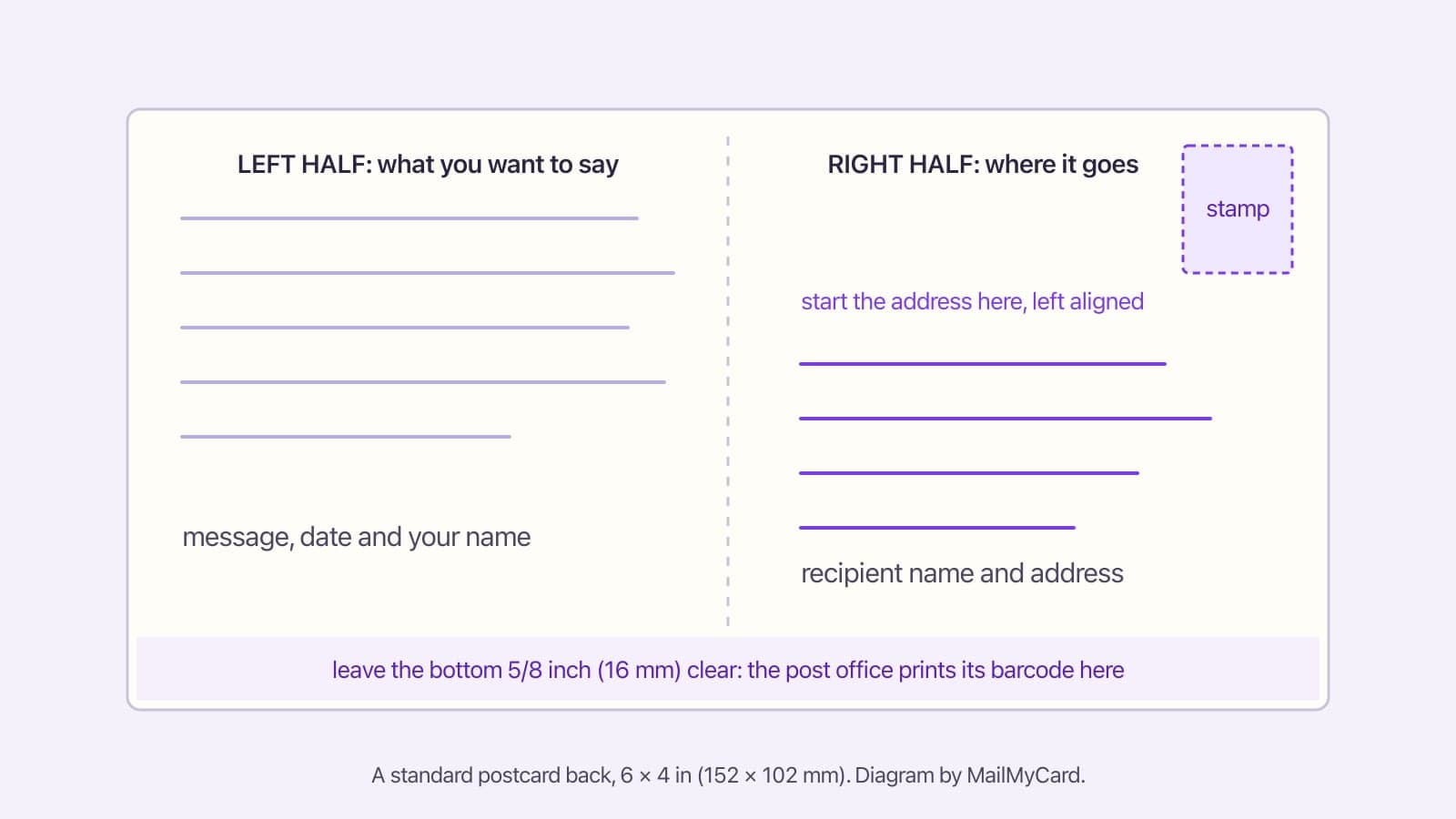
The back of a postcard is split down the middle. The left half is yours: message, date and signature. The right half belongs to the post office: the recipient's address in the middle, the stamp in the top right corner, and a clear strip along the bottom where sorting machines print a barcode. Keep your writing out of the right half and off the bottom edge and the card will sort cleanly.
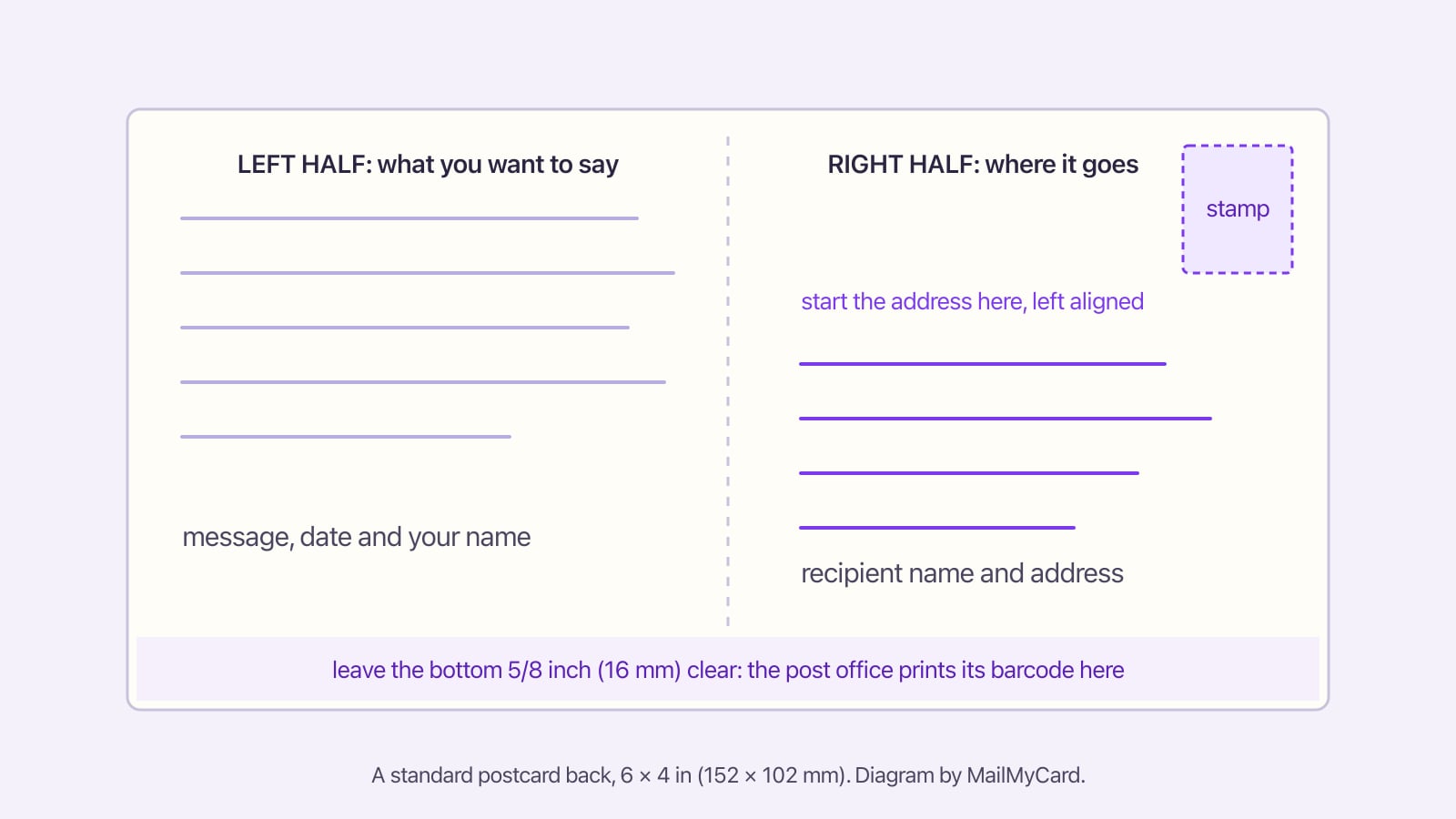
Most postcards are 6 × 4 inches (152 × 102 mm). In the United States, the USPS Domestic Mail Manual, section 201 sets the postcard-rate limits at a minimum of 3½ × 5 inches and a maximum of 4¼ × 6 inches, between 0.007 and 0.016 inches thick. Anything bigger travels at the letter rate. Royal Mail treats a postcard up to 24 × 16.5 cm as a letter and charges the letter price.
How much can you fit on a postcard?
Around forty to sixty words at a normal handwriting size. The message half of a 6 × 4 card is roughly 3 × 4 inches, which gives you five or six lines of about ten words each. Write smaller and you gain a line or two but lose legibility. Pick the two or three things you most want to say and leave the rest for the next card.
If you are typing your note for a pen to write, the same rule holds. Our editor previews the card at real size so you see when the message stops fitting, and we shrink the handwriting rather than cutting a sentence. Fifty words looks generous on screen and just right on cardstock.
What should you write on a postcard?
Use five short parts. Each is one line, and none is optional except the greeting and the name.
- Greeting with their name. "Dear Priya," or "Hi Grandpa,". The name matters more on a postcard than in an email because the card is one of a kind.
- One concrete detail. Not "the trip is great" but "we ate grilled sardines on a pier in Cascais and a gull stole Ben's bread". Specific beats broad in fifty words.
- One line about them. "You would have loved the tile shops." A postcard that is only about you reads like a diary entry.
- A small promise or wish. "Back on the 14th, dinner soon?" It gives the card a next step.
- Sign-off and name. "Love, Anita" or "Cheers, the Okafors". Add the date and place in the top corner; people keep postcards, and the date is what they look for years later.

A 2018 study by Amit Kumar and Nicholas Epley in Psychological Science found that people who wrote thank-you notes consistently underestimated how surprised and how pleased the recipients would be, and overestimated how awkward the recipients would find the note (University of Chicago News). The worry that your postcard will sound silly is the same miscalculation. Send it.
Postcard message examples
Copy any of these and change the details. Each fits on a standard card with room for a signature.
Holiday
Dear Mum, Lisbon is all yellow trams and steep streets. We climbed to the castle at sunset and I thought of your photos from 1989. Same view, better cameras. Home Sunday, tell you everything then. Love, Sam
Hi Jonah, greetings from a rainy Edinburgh. Saw three bagpipers, two castles and one very unimpressed cat. You would have loved the ghost tour. Back Tuesday. Uncle Dev
Thank you
Dear Aunt Rosa, thank you for the weekend, the lemon cake and the spare room with the good pillows. Next time you come to us and I cook. Love, Leah
Hi Marcus, thanks for covering my shifts last week. I owe you a proper lunch, not a cafeteria one. Say when. Tom
Birthday
Happy birthday, Grandad! Seventy-eight years and still beating me at chess. I am practising. Expect a rematch at Christmas. Love always, Ellie
Dear Noor, happy birthday from across the ocean. I hope the year brings you the garden you keep talking about. Call you Sunday. Your friend, Ana
Just because
Hi Dad, no reason for this card except that I passed the bakery you like and thought of you. The cinnamon buns are still too big. Love, Kit
Dear Hana, it has been too long since I wrote anything by hand. So: I miss you, the new flat has a view of a car park, and I have started running. Come see both. Zoë
From a business
Hi Ravi, thank you for your first order with us. Your mug left the studio this morning, wrapped by hand. If the glaze is not what you hoped, reply to this card and we will sort it. Meera, Ochre Ceramics
Dear Ms Chen, welcome to the neighbourhood from everyone at Hollis Pharmacy. We are open until 8 on weekdays, and we deliver. Ask for Dan. The Hollis team
Sympathy and recovery
Dear Frank, I was so sorry to hear about Joan. She once talked me through a flat tyre over the phone for forty minutes. Thinking of you. With love, Bea
Get well soon, Coach! The whole team signed a card but I wanted to send my own. We are keeping the drills going. See you on the pitch. Oli
How do you address a postcard?
Write the recipient's full name, street address, town, postcode and, if it is crossing a border, the country in capitals on the last line. Keep the block left-aligned in the right half of the card, with each item on its own line. The stamp goes in the top right corner above the address. The full format for the US, UK, India and abroad is in our guide to addressing a postcard. If the card is from a shop rather than a holiday, the thank-you notes for customers are written for that.
How much does a postcard stamp cost?
The postcard rate is usually the cheapest thing a post office sells, and it only applies to cards within the size limits above. Prices as checked on 24 September 2026:
| Country | Postcard, domestic | Letter, domestic | Postcard abroad |
|---|---|---|---|
| United States (USPS) | $0.65 | $0.82 | $1.75 (Global Forever) |
| United Kingdom (Royal Mail) | 91p 2nd class, £1.80 1st class | same as postcard | from £3.20 |
| India (India Post) | ₹0.50 | ₹5 (up to 20 g) | ₹12 to ₹15 by region |
Royal Mail's prices rose to £1.80 and 91p on 7 April 2026 and do not distinguish a postcard from a letter. USPS sets the Global Forever stamp at one price for every country. India Post's plain postcard has cost 50 paise since 2002, which is why it still moves in the hundreds of millions every year.
How long does a postcard take to arrive?
Within the United States, USPS quotes one to five business days for First-Class Mail, which includes postcards. Across borders, allow two to three weeks. Postcrossing, the postcard-exchange community, has tracked more than 88 million postcards between its members in 207 countries, and reports a median travel time of 20 days (Postcrossing statistics).
Our own cards are written and posted from Bengaluru on the day you order them. These are the delivery windows we quote, taken from the same table our checkout uses:
| Destination | Standard (included) | Tracked | Express courier |
|---|---|---|---|
| India | 3 to 7 days | 3 to 7 days, tracked | 2 to 5 days |
| United Arab Emirates | 6 to 12 days | 6 to 12 days, tracked | 2 to 4 days |
| Singapore | 6 to 12 days | 6 to 12 days, tracked | 2 to 5 days |
| United Kingdom, Germany | 7 to 14 days | 7 to 14 days, tracked | 3 to 6 days |
| United States | 8 to 15 days | 8 to 15 days, tracked | 3 to 6 days |
| Canada, Australia | 8 to 15 days | 8 to 15 days, tracked | 4 to 7 days |
Standard post is included in the card price. Tracked adds a tracking number for a small upgrade, and Express hands the card to a courier for a delivery in days rather than weeks; both are priced at checkout for the destination you enter. Businesses sending cards in volume get the same windows and a per-card price on the For business page.
Postcard mistakes that get cards delayed or lost
- Writing into the address half. Sorting machines read the right side of the card. A message that wanders across the middle line can be misread as part of the address.
- Writing along the bottom edge. The bottom 16 mm (⅝ inch) is where the postal barcode is sprayed. Words there get printed over.
- Skipping the country. A card from London to Sydney that says only "NSW 2000" may take the scenic route. Put the country in capitals on the last line.
- Using an oversized card at postcard postage. Above 4¼ × 6 inches USPS charges the letter rate; underpaid cards are returned or delivered postage due.
- Forgetting the date. Cards get kept for years. A date turns a note into a record.
- Pencil or water-soluble ink. Postcards travel bare. Use a ballpoint or a pigment pen so rain and thumbs do not smudge the address.
Sources
- USPS, Domestic Mail Manual 201, physical standards for postcards: pe.usps.com/text/dmm300/201.htm
- USPS, current postage prices: usps.com/business/prices.htm
- Royal Mail, price finder and 2026 prices: royalmail.com/price-finder
- India Post, postage rates: indiapost.gov.in
- Postcrossing, postcard statistics: postcrossing.com/stats/postcards
- Kumar, A. and Epley, N. (2018), "Undervaluing Gratitude: Expressers Misunderstand the Consequences of Showing Appreciation", Psychological Science, summarised by University of Chicago News