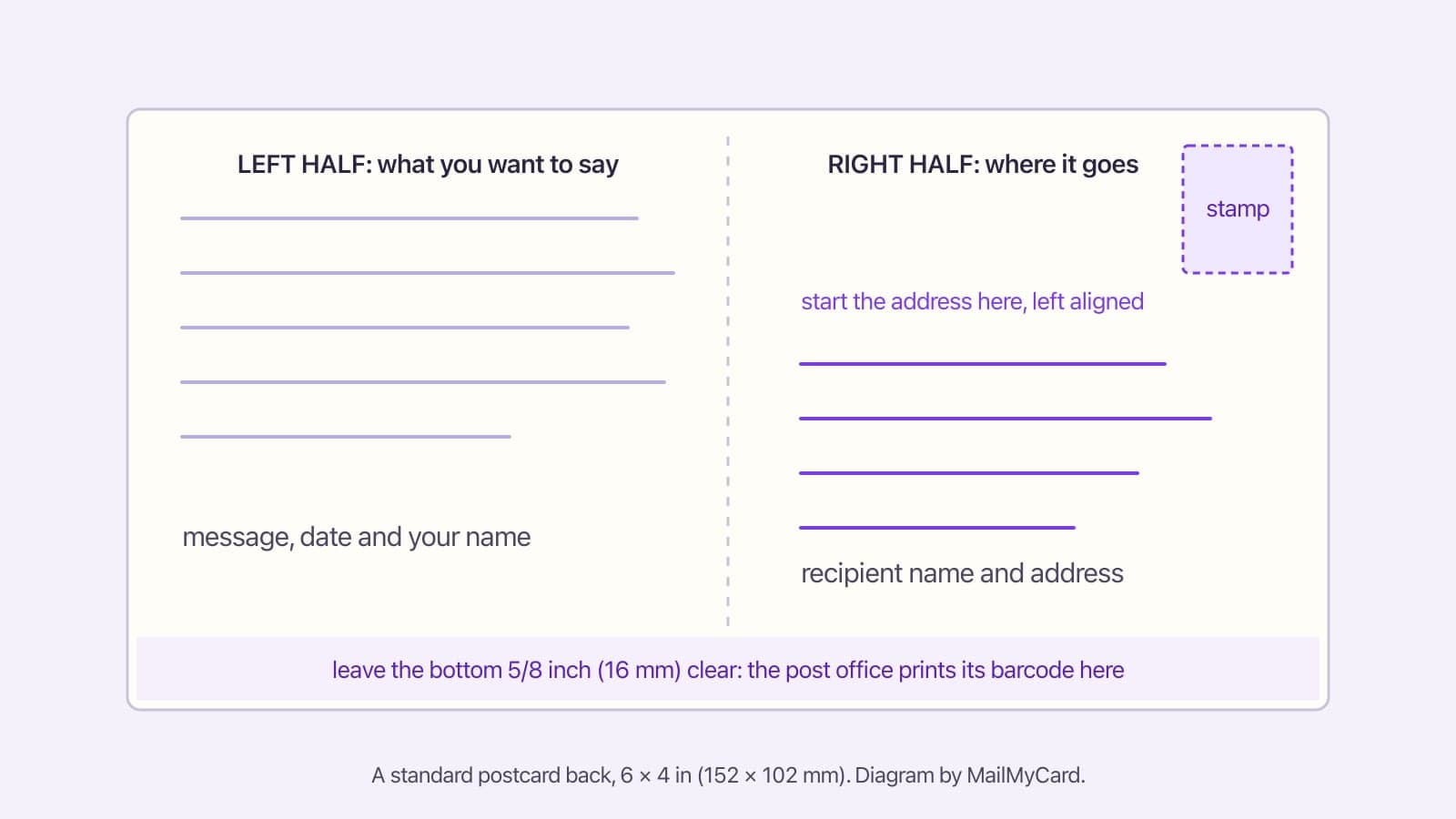
Write the address in the right half of the postcard's back, left-aligned, one item per line: the person's full name, the street address, the town, the postcode, and, if the card is leaving the country, the country name in capitals on the last line. Put the stamp in the top right corner. Leave the bottom strip of the card empty. Your message stays on the left half; what to put there is covered in how to write a postcard.
Get those four things right and the card will sort by machine anywhere in the world. The rest of this guide gives the exact line order for the countries we post to most, and the handful of mistakes that send cards on a detour.
Where does the address go on a postcard?
In the right half of the back, starting roughly a third of the way down. Most printed postcards mark the space with faint lines or a vertical divider; if yours is blank, imagine the card split down the middle and keep the address entirely to the right of that line. Start each line at the same left edge. Do not centre the block, and do not let the message cross into it.
Where does the stamp go on a postcard?
Top right corner of the back, on the same side as the address. Sorting machines look there first. A stamp anywhere else can still be accepted by a person at the counter, but a machine may reject the card to manual handling, which adds days. If your card needs two stamps, place them side by side along the top edge, working leftwards from the corner.

What is the correct postcard address format?
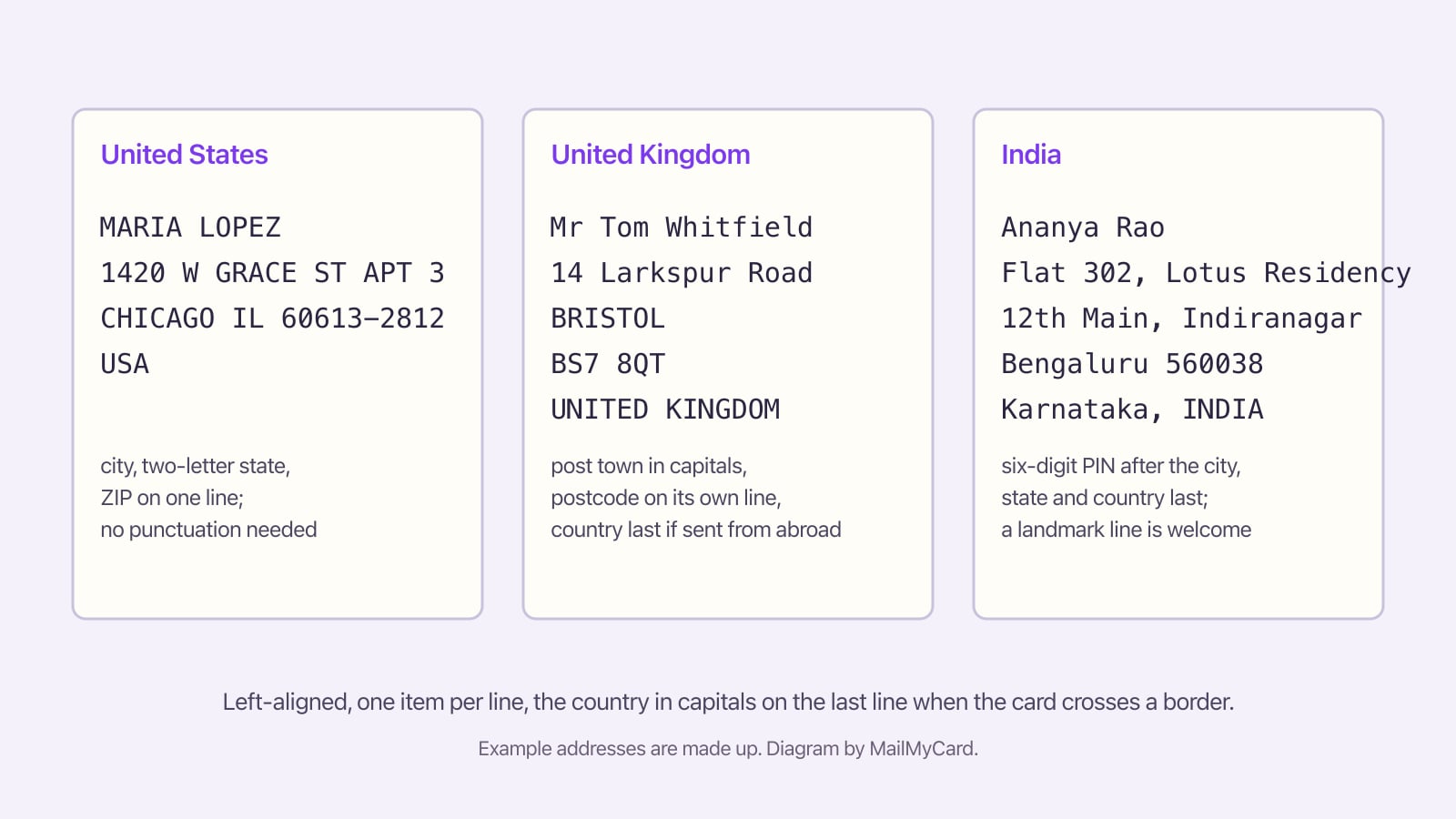
Every postal service wants the same information in the same rough order, from the most specific line to the least: person, building and street, locality, postcode, country. The differences are in punctuation, capitals and where the postcode sits. Here are the five formats we write most often.
United States
MARIA LOPEZ
1420 W GRACE ST APT 3
CHICAGO IL 60613-2812
USPS prefers capitals, no punctuation, and city, two-letter state and ZIP code together on one line. The apartment or unit goes on the street line, after the street. The four-digit ZIP extension is optional but speeds sorting. Add USA as a final line when the card is coming from abroad.
United Kingdom
Mr Tom Whitfield
14 Larkspur Road
BRISTOL
BS7 8QT
Royal Mail asks for the post town in capitals and the postcode on its own line, last. Do not put a county unless the address is ambiguous without it. From outside the UK, add UNITED KINGDOM below the postcode.
India
Ananya Rao
Flat 302, Lotus Residency
12th Main, Indiranagar
Bengaluru 560038
Karnataka
India Post sorts on the six-digit PIN code, which goes after the city on the same line. A locality or landmark line helps the last-mile carrier. Add INDIA as the final line from abroad.
Canada
JEAN TREMBLAY
250 RUE SAINT-PAUL O APP 4
MONTRÉAL QC  H2Y 2A3
Canada Post's format mirrors the US one: city, two-letter province and postal code on a single line, with two spaces before the postal code. From abroad, CANADA goes on the last line.
Australia
Ms Grace Nguyen
7/22 Brunswick Street
FITZROY VIC 3065
Australia Post wants the suburb in capitals followed by the state abbreviation and four-digit postcode. A unit number is written before the street number with a slash. Add AUSTRALIA as a last line from overseas.
How do you address an international postcard?
Write the address exactly as the destination country writes it, then add the country name in capital letters, in English or French, on its own last line. This follows the Universal Postal Union addressing guidance, which every member post follows. The country line is the only part the sending post office reads; everything above it is for the receiving country's sorters. Do not translate street names or add the country's name in the middle of the block.
If the destination uses another script, such as Japan or Russia, write the local-script address if you can, and repeat the town and country in Latin capitals underneath. When we pen a card for you, the address is written from the text you type, so paste it as the recipient would write it themselves. Cards sent from a store connection take the address straight from the order, which is how the thank-you cards for customers go out without anyone retyping it.
How much is a stamp for a postcard?
| Sent from | Domestic postcard | International postcard |
|---|---|---|
| United States | $0.65 | $1.75 (Global Forever, any country) |
| United Kingdom | 91p 2nd class, £1.80 1st class | from £3.20 |
| India | ₹0.50 | ₹12 to ₹15 by region |
Prices are as published on the USPS, Royal Mail and India Post rate pages on 24 September 2026. Royal Mail treats a postcard up to 24 × 16.5 cm as a letter, so there is no separate postcard stamp. In the United States the cheaper postcard rate only applies within the USPS size limits: at least 3½ × 5 inches and at most 4¼ × 6 inches, per the Domestic Mail Manual, section 201.
How long does an addressed postcard take to arrive?
USPS quotes one to five business days for a domestic First-Class postcard. Internationally, Postcrossing's members have exchanged more than 88 million postcards and the site reports a median travel time of 20 days (Postcrossing statistics). A clean, machine-readable address is the biggest thing you control in that number.
For cards we post from Bengaluru, these are the windows our checkout shows. Standard post is included; Tracked and Express are upgrades priced at checkout for the destination:
| Destination | Standard (included) | Tracked | Express courier |
|---|---|---|---|
| India | 3 to 7 days | 3 to 7 days, tracked | 2 to 5 days |
| United Arab Emirates | 6 to 12 days | 6 to 12 days, tracked | 2 to 4 days |
| Singapore | 6 to 12 days | 6 to 12 days, tracked | 2 to 5 days |
| United Kingdom, Germany | 7 to 14 days | 7 to 14 days, tracked | 3 to 6 days |
| United States | 8 to 15 days | 8 to 15 days, tracked | 3 to 6 days |
| Canada, Australia | 8 to 15 days | 8 to 15 days, tracked | 4 to 7 days |
Express is the one to pick when the card has to land before a date. Businesses posting in volume get the same windows at the per-card prices on the For business page.
Addressing mistakes that delay postcards
- Writing in the bottom strip. USPS reserves a barcode clear zone along the bottom ⅝ inch (16 mm) of the card (DMM 202). Ink there gets sprayed over, and a barcode that lands on your handwriting misreads.
- Centring the address. Machines find the block by its left edge. Centred lines look tidy and sort badly.
- Missing the country line. "NSW 2000" is only Sydney if the card is already in Australia.
- Putting the postcode on the wrong line. UK postcodes go on their own last line; US and Canadian ones share the city line; Indian PINs follow the city. Swapping them is the most common international error we correct.
- A stamp on the picture side. It will usually still arrive, but by hand, days later.
- Return address on the back. Postcards rarely carry one, but if you add it, write it small in the top left of the message half, never in the address half.
Sources
- Universal Postal Union, addressing solutions and postal addressing standards: upu.int
- USPS, Domestic Mail Manual 201 (postcard physical standards) and 202 (barcode clear zone): pe.usps.com/text/dmm300
- USPS, postage prices: usps.com/business/prices.htm
- Royal Mail, price finder: royalmail.com/price-finder
- India Post, postage rates: indiapost.gov.in
- Postcrossing, statistics: postcrossing.com/stats/postcards